Present Head
History
Origin and Foundation of Charkhari State
The history of Charkhari State is deeply intertwined with the legacy of the Bundela Rajputs, who established their hegemony over the rugged terrain of Bundelkhand. The origins of the state date back to the legendary Bundela warrior-king, Maharaja Chhatrasal, who successfully resisted Mughal expansion and carved out a massive independent kingdom in Central India. Upon his death in 1731, Maharaja Chhatrasal partitioned his vast territories among his sons and allies to ensure administrative stability. The second portion of his realm, which centered around Jaitpur, was bestowed upon his second son, Raja Jagat Raj.
Following the death of Raja Jagat Raj in 1757, a bitter succession dispute erupted within the family. His son, Raja Pahar Singh, seized control of the Jaitpur territory, driving his nephew, Raja Khuman Singh, into exile. After years of skirmishes and political negotiations, an amicable settlement was finally brokered in 1764. Under this agreement, Khuman Singh was granted the sovereign territory of Charkhari. In 1765, he formally ascended the throne as the first independent Raja of Charkhari, marking the birth of Charkhari State as a distinct political entity in Central India.
The Era of Maratha Dominance and British Alliance
During the late 18th century, Bundelkhand became a battleground for competing regional powers, particularly the Maratha Empire and various local Bundela chieftains. Raja Khuman Singh defended his newly formed principality from external incursions until his death in 1782. He was succeeded by his son, Raja Bijai Bahadur, whose reign coincided with the expansion of the British East India Company into Northern and Central India.
As the Maratha confederacy weakened and British influence surged, Raja Bijai Bahadur made a strategic alliance with the British forces. In 1804, following the Second Anglo-Maratha War, Charkhari entered into a treaty of alliance with the British East India Company. The British government granted a protective Sanad (charter) to Raja Bijai Bahadur, confirming his ancestral lands and safeguarding the state from the territorial ambitions of neighboring rulers and Maratha commanders. This treaty firmly placed Charkhari under the protection of the British Crown, eventually integrating it into the Bundelkhand Agency.
The Indian Rebellion of 1857 and Imperial Recognition
Charkhari played a critical role during the Indian Rebellion of 1857. Under the rule of Raja Ratan Singh, the state chose to remain staunchly loyal to the British East India Company. This decision put Charkhari in the direct line of fire of the rebel forces. In early 1858, the legendary rebel leader Tantia Tope, allied with the forces of Jhansi and local mutineers, besieged Charkhari. Despite facing overwhelming military odds, Raja Ratan Singh held out against the rebel forces, protecting British refugees and maintaining communication lines for the British Army.
For his unwavering loyalty during the crisis, Raja Ratan Singh was lavishly rewarded by the British Crown after the suppression of the rebellion. The British government granted him a permanent salute of 11 guns, a substantial jagir (land grant) yielding large annual revenues, and the hereditary title of Maharaja. Furthermore, the British wiped out the state's existing debts as a gesture of appreciation for his military and administrative assistance.
Military Might, Administration, and Heraldry
By the late 19th century, Charkhari had developed into a highly organized princely state. According to historical records from 1893, the Maharaja maintained a well-disciplined military force consisting of 188 cavalry, 1,552 infantry, and 42 guns. The state was entitled to an 11-gun salute, reflecting its high status among the salute states of the Bundelkhand Agency.
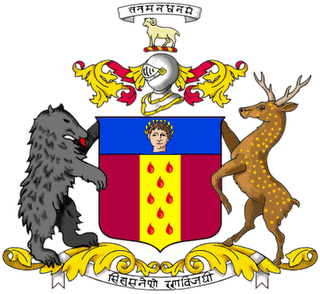
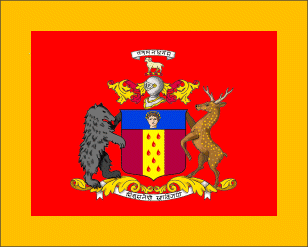
The state's heraldry and insignia reflected its martial Rajput heritage and deep-seated devotion to duty. The coat of arms of Charkhari prominently featured Bundela Rajput motifs, flanked by royal symbols of authority. The official motto of the ruling family of Charkhari is:
"Singhasanesho ran Vijayi" (Translated: "The Master of the Throne is the Victorious in War")
This motto served as a constant reminder of the state’s foundation through military perseverance and the warrior code of the Bundela clan.
Key Reformers and Modernization
The late 19th and early 20th centuries marked an era of extensive modernization and social reform in Charkhari, primarily under the rule of Maharaja Malkhan Singh (who ascended the throne in 1880). Malkhan Singh was an enlightened ruler who prioritized public education, modern healthcare, and agricultural reforms. He established the Malkhan High School, modernized the state's judicial system, and constructed several reservoirs to protect the agrarian economy from the frequent droughts that plagued the Bundelkhand region.
Subsequent rulers, including Maharaja Jay Singh Deo, continued these progressive policies. They improved transport infrastructure, established connectivity with the colonial railway network, and promoted local Bundeli arts, crafts, and literature, turning the capital city of Charkhari into a cultural oasis often referred to locally as the "Kashmir of Bundelkhand" due to its picturesque lakes and fortresses.
Post-Independence Integration and Modern Legacy
Following India's independence from British rule in August 1947, Maharaja Jay Singh Deo signed the Instrument of Accession, merging the princely state of Charkhari into the Union of India. In 1948, Charkhari was officially integrated into the newly formed state of Vindhya Pradesh. Following the reorganization of Indian states in 1956, Vindhya Pradesh was dissolved, and the territory of Charkhari was eventually integrated into the Mahoba district of Uttar Pradesh.
Today, the historical legacy of Charkhari lives on through its magnificent palaces, temple complexes, and water-harvesting lakes built by the Bundela kings. The descendants of the royal family remain respected cultural custodians of the region's rich heritage.
References and Historical Sources
- The Imperial Gazetteer of India, detailed historical records of Charkhari State can be explored via the Digital South Asia Library at the University of Chicago.
- Archived documents on the Bundelkhand Agency and treaty records of 1804 are preserved in the Internet Archive.
- For details on post-independence integration of princely states, refer to the historical archives of the Government of India National Portal.
Genealogy
- Raja KHUMAN SINGH, 1st Raja of Charkhari 1765/1782, son of Kunwar Kirat Singh (younger brother of Raja Jagatraj Singh of Jaitpur), married and had issue, one son. He died .
- Raja Vijay Bahadur Singh [Vikramaditya] (qv)
- generations
- HH Maharajadhiraj Sipahdar-ul-Mulk Jujhar Singh Ju Deo (qv)
- HH Maharajadhiraj Sipahdar-ul-Mulk Ganga Singh Ju Deo (qv)
- Diwan Uttam Singh Judeo, married and had issue. he died .
- Diwan Raghuraj Singh Judeo
- Diwan Baldev Singh Judeo.
- Raja VIJAY BAHADUR SINGH, 2nd Raja of Charkhari 1782/1829, continually feuding with his relatives, he was finally driven out of his possessions. In 1789, he sided with Ali Bahadur who granted him a sanad of possession of Charkhari Fort in 1798. He was the first chief to enter into relations with the British in Bundelkhund, who granted him sanads in 1804 and 1811, married in Karaiya, and had issue, three sons, as well as natural issue. He died .
- Kunwar Ishwari Singh, died .
- Kunwar Puran Mal, died .
- Kunwar Govind Das, died .
- [?Diwan Hamir Deo, died /1835.]
- Kunwar Ranjit Singh (natural son), confirmed in 1822 (when the Rajas legitimate sons died ), as eventual successor in Charkhari, married and had issue. He died vp before 1829.
- Raja Ratan Singh (qv)
- Raja RATAN SINGH, 3rd Raja of Charkhari 1829/1860, born , during the mutiny, he loyally served the British and was rewarded with a land grant in perpetuity of the value of 20,000Rs per annum, a khilat, a hereditary salute of 11 guns, and the privilege of adoption, which was later confirmed by the sanad of 1862, married and had issue. He died .
- Raja Jai Singh Deo (qv)
- Raja Sipahdar-ul-Mulk JAI SINGH Deo, 4th Raja of Charkhari 1860/1880, born , a minor at accession, he obtained administrative powers in 1874, but mismanagement necessitated the appointment of a British officer as a superintendent in 1879, and the withdrawal of the Rajas powers in 1880, he attended the Imperial Assemblage at Delhi in January 1877, and in celebration of the Proclamation of Her Gracious Majesty as Empress of India received the additional title of Sipadar-ul-Mulk married and had issue. Unsound of mind, he committed suicide in 1880.
- HH Maharajadhiraj Sipahdar-ul-Mulk Sir MALKHAN SINGH Ju Deo Bahadur, 5th Maharaja of Charkhari 1880/1908, Maharaja [cr.1880], K.C.I.E. [cr.1902], born , son of the Diwan of Charkhari (later Maharaja), adopted by the Rani of the deceased Raja, he succeeded to the gadi on 10th July 1880, he attained his majority in January 1892, and assumed the Government of his State at a grand Darbar held at Charkhari on 10th November 1892. He died sp on 6th July 1908 (1933)
- HH Maharajadhiraj Sipahdar-ul-Mulk JUJHAR SINGH Ju Deo, 6th Maharaja of Charkhari 1908/1914, Diwan of Charkhari, married and had issue, at least one son.
- HH Maharajadhiraj Sipahdar-ul-Mulk Sir Malkhan Singh Ju Deo Bahadur (see above)
- HH Maharajadhiraj Sipahdar-ul-Mulk GANGA SINGH Ju Deo, 7th Maharaja of Charkhari 1914/1920, he adopted his own paternal grandson as his successor in Charkhari in January 1920; married and had issue, as well as adoptive issue.
- Rao BHANU PRATAP SINGH, he was adopted by the Rao of Jigni, and succeeded there as Rao Bhanu Pratap Singh of Jigni, married and had issue.
- HH Maharajadhiraj Sipahdar-ul-Mulk Sir Arimardan Singh Ju Deo Bahadur (qv)
- (A) HH Maharajadhiraj Sipahdar-ul-Mulk Sir Arimardan Singh Ju Deo Bahadur (qv)
- Rao BHANU PRATAP SINGH, he was adopted by the Rao of Jigni, and succeeded there as Rao Bhanu Pratap Singh of Jigni, married and had issue.
- HH Maharajadhiraj Sipahdar-ul-Mulk Sir ARIMARDAN SINGH Ju Deo Bahadur, 8th Maharaja of Charkhari 1920/1941, born , married 1stly, 1923, HH Maharani (name unknown) of Virpur, she died sp in 1923, married 2ndly, 1928, Maharaj Kumari Amba Kunwari Sahib, daughter of HH Maharawal Prithvi Singhji of Banswara, married 3rdly, 1931, a daughter of HH Maharaja Sri Tin Mohun Shumshere Jung Bahadur Rana of Nepal married 3rdly, 1934, Maharani Tara Devi [Tulsa Devi], daughter of Thakur Dewan Singh of Almora. He died sp 8th November 1941.
- HH Maharajadhiraj Sipahdar-ul-Mulk JAYENDRA SINGH Ju Deo, 9th Maharaja of Charkhari 1942/1977, born , son of Maharaja Mahipal Singh Ju Deo of Sarila, succeeded by adoption in 1942, married HH Maharani Jayati Devi [now HH Rajmata Jayati Devi of Charkhari], daughter of Capt. HH Bisam-Samar-Bijayi Mahamahodya Pancha-Srijukta Maharaja Manikya Sir Bir Bikram Kishore Dev Varman Bahadur, Maharaja of Tripura, and had issue. He died .
- HH Maharajadhiraj Sipahdar-ul-Mulk Jayant Singh Ju Deo (qv)
- Maharajkumar Jaydev Singh Ju Deo
- Maharaj Kumari Natasha Singh Ju Deo, born , lives in London UK.
- Maharajkumar Jayveer Singh Ju Deo
- Raja Jayvardhan Singh Ju Deo
- HH Maharajadhiraj Sipahdar-ul-Mulk JAYANT SINGH Ju Deo, 10th Maharaja of Charkhari since 7th January 1977 (Fort Charkhari, Rao Bagh Palace, P.O. Charkhari Dist. Mahoba, Uttar Pradesh - 210421, India). Born in Mussoorie, educated at Delhi University (B.A., 1972) and at Mumbai University (M.A., History and Political Science, 1974); Patron of various Social and Religious Organizations, married 27th April 1978 in New Delhi, HH Maharani Urmila Kumari, the younger daughter of Raja Shivraten Singh of Poonch, elected Mayor of Charkhari (Independent), thereby controlling the entire Charkhari Municipal Area, and has issue.
- Maharaj Kumari Jayati Kumari, born in Shillong, married in March 2011, Shri Bawa Jai Singh.
- Raja Bahadur Jayy Singh Judeo, born in Shillong. Education from Mayo College (2003 Batch), college from PIHMS, New Plymouth, New Zealand. Works at Millbrook Resort, New Zealand. He currently lives at Queenstown.
- Maharaj Kumar Jayraj Singh Judeo, born in Shillong. Worked in New Zealand, returned to India to join politics.
- HH Maharajadhiraj Sipahdar-ul-Mulk JAYY SINGH Ju Deo, 10th Maharaja of Charkhari (see above)
Notable Figures
Maharaja Bijai Bahadur Singh (1765–1829)
Maharaja Bijai Bahadur Singh (also spelled Vijay Bahadur) was the founder of the Charkhari Princely State, carving it out of the historic Jaitpur State in 1765. He was the grandson of Maharaja Jagat Raj of Jaitpur and a direct descendant of the legendary Bundela warrior-king Maharaja Chhatrasal. Following the expansion of the British East India Company into Central India, Bijai Bahadur entered into a treaty alliance with the British, receiving a confirmatory sanad (charter) in 1804 and 1811, which secured his sovereign rights over the territory.
His reign was marked by the consolidation of the state's borders and the establishment of Charkhari town as a cultural and administrative center. He patronized local Bundeli art, literature, and temple architecture, laying the foundation for Charkhari to be known as the 'Kashmir of Bundelkhand' due to its scenic lakes and hills. More details on his reign can be found on the Charkhari State Wikipedia Page.
Maharaja Ratan Singh (1829–1860)
Maharaja Ratan Singh succeeded Bijai Bahadur Singh to the throne of Charkhari. His reign is most notable for his strategic stance during the Indian Rebellion of 1857. Unlike many of his contemporaries in the Bundelkhand region who joined the uprising against the British East India Company, Ratan Singh remained fiercely loyal to the British Crown. He provided sanctuary, provisions, and military assistance to British officers fleeing from neighboring rebel-held territories.
In recognition of his unwavering support, the British government rewarded him after the rebellion with the hereditary title of Maharaja, a perpetual khillat (robe of honor), an annual political pension, and a personal salute of 11 guns. This elevated Charkhari's status significantly within the colonial hierarchy. Historical records of this period are detailed in the Imperial Gazetteer of India.
Maharaja Jai Singh Deo (1860–1880)
Maharaja Jai Singh Deo succeeded Ratan Singh in 1860. Adopted into the ruling family, he initially ascended the throne under a regency council due to his minority. His reign witnessed a shift towards modern bureaucratic governance, with the British Bundelkhand Agency exerting considerable influence over the state's internal affairs.
Under his rule, Charkhari saw early structural and municipal developments, including the construction of metalled roads, public buildings, and improvements in the local revenue administration. His tenure helped stabilize the state's finances after the turbulent decades of mid-19th-century conflicts.
Maharaja Malkhan Singh (1880–1908)
Maharaja Malkhan Singh ascended the gaddi (throne) of Charkhari in 1880 as a minor, with the state initially managed by a superintendent appointed by the British Government until he attained full ruling powers in 1894. He was an enlightened and highly educated ruler who implemented extensive administrative, judicial, and agricultural reforms across his territory.
Malkhan Singh was highly regarded for his philanthropic works, particularly during the devastating Bundelkhand famines of 1895–1897 and 1899–1900, where he established state-funded relief kitchens and waived land revenues for distressed farmers. He attended the historic Delhi Durbar in 1903 and was invested as a Knight Commander of the Order of the Indian Empire (KCIE). His contributions are documented in the Dictionary of Indian Biography.
Maharaja Jujhar Singh Ju Deo (1908–1914)
Maharaja Jujhar Singh Ju Deo succeeded Malkhan Singh in 1908. He was a veteran administrator who had previously served as the Dewan (Prime Minister) of the state under his predecessor's reign. Because of his extensive administrative experience, his transition to the throne was seamless, and he maintained a stable, prosperous administration.
His short reign was characterized by the continuation of social welfare programs, the expansion of primary education in rural areas, and the preservation of traditional Bundela culture. He was honored by the British government with the title of Companion of the Order of the Indian Empire (CIE) for his administrative efficiency.
Maharaja Ganga Singh Ju Deo (1914–1920)
Maharaja Ganga Singh Ju Deo ascended the throne of Charkhari during the onset of the First World War. His reign was largely dominated by the state's contributions to the British war effort. Under his leadership, Charkhari provided substantial financial grants, war loans, and recruited local soldiers to serve in the Indian Expeditionary Forces overseas.
Despite the economic pressures of the wartime period, Ganga Singh managed to keep the state's agrarian economy functional. He passed away in 1920, leaving behind a legacy of loyalty and financial support to the Allied cause.
Maharaja Arimardan Singh Ju Deo (1920–1941)
Maharaja Arimardan Singh Ju Deo succeeded Ganga Singh in 1920. His reign coincided with the rise of the Indian national movement, which began to find echoes within the princely states of Bundelkhand. Arimardan Singh navigated these political shifts by introducing cautious political reforms while maintaining the traditional authority of the durbar.
He took a deep interest in the conservation of Charkhari’s historical fort and its numerous lakes, preserving the unique ecological landscape of the region. He also patronized sports, especially equestrian events and traditional Indian wrestling, making Charkhari a recognized center for regional athletes.
Maharaja Jayendra Singh Ju Deo (1941–1947)
Maharaja Jayendra Singh Ju Deo was the last ruling Maharaja of Charkhari State. Ascending the throne during the height of the Second World War, he faced immense political transitions as India moved rapidly towards independence from British colonial rule.
Following India's independence in August 1947, Maharaja Jayendra Singh signed the Instrument of Accession, merging Charkhari State into the newly formed United State of Vindhya Pradesh in 1948. Later, the territory became part of Madhya Pradesh before being reorganized into the Mahoba district of Uttar Pradesh. His cooperation during the integration of princely states was highly commended by the Ministry of States under Sardar Vallabhbhai Patel. For more details on the political transition, refer to the Vindhya Pradesh History on Wikipedia.


